I've been asked occasionally about the significance of the drawing in the photo currently at the top of this blog. It's part of a comic strip about Deaf women's oppression at the gynecologist. I took the photo while I was at the Korean Disabled Women's United conference in Seoul, where they had art and photos by women with disabilities on display. The comic is written in Korean, and unfortunately I don't read Korean, so my understanding of the strip was that this frame shows a pregnant Deaf woman getting a gynecological exam at a doctor's office. The woman is lying back on the exam table with her legs spread. There is no sign language interpreter present and she does not know why the doctor is giving her the exam. There is an I-love-you handshape drawn where her vagina would be. So, imagine being pregnant, Deaf, alone at the doc's office with some person getting ready to root around in your vagina. What the heck is going on?
What I'd be really worried about is whether this doctor is going to let her have her baby safely and whether she will be able to keep her baby in the face of social opposition to disability. When she gives birth, will she be sterilized without her consent, as has happened to so many Deaf women here in the United States and around the world? And then, as we globally progress into a reality where prenatal genetic testing has a role, I would wonder if the doctor has advised her about those tests and whether, in her country, she would be allowed to keep a child who might also be Deaf---a reality in which, because of communication isolation, the woman might very well not know anything about.
I could just be thankful that the artist presumes a reality where the Deaf woman has access to medical services of any kind whatsoever, in contrast to areas of the world where medical services are nonexistent. As a human being, however, why should I say that that is enough? Everyone should have access to the kind of medical care they need to be as healthy as possible and to be as self-directed as possible.
On a personal level, if I happened to be born in Korea, and if I happened to have a slightly greater hearing loss and slightly less skill in lip reading, the comic above could very well be my reality. As it is, every time I go to any kind of doctor, it's like I have to get ready to do battle to make sure I understand absolutely everything they are telling me. I don't use an interpreter, since doctors' offices are usually quiet, but I do make them face me when they speak, tell me what they are doing before they do anything I can't see, and write down what they have to say if I cannot understand it. I avoid doctors whose speaking styles I can't understand. I am aware that being able to do this gives me more of a hearing privilege than someone who needs to rely on a sign language interpreter for every piece of information, but I must assert that it is still a battle, and I know that things can go very wrong if even one piece of information is miscommunicated. It oppresses me, and any Deaf or hard of hearing person, that we have to be in this state of war every time we are in a medical (or legal) environment.
Furthermore, as a woman, I'm concerned with how my doctor perceives me as a woman, whether my doctor is a woman or a man. I could be unconcerned, but I'd be ignoring a basic social reality. In Korea, men rank above women in the social hierarchy, no question about it. So in the comic, would that woman feel able to stand up for herself? Everyone, everywhere, has some idea about what it means to be a woman or a man, and if you don't meet those expectations, that creates a hostile environment, breaking down trust.
The last time I saw a male doctor, my female doctor was out of town and I agreed to see him as a backup. He turned out to be very tall (intimidating) and good looking (distracting) and still a new doctor (nervewracking). Is it his fault he is that way? Not really. Can I help my response? Maybe. Did I receive good health care? Good enough. Did I feel comfortable? No, because my normal behavior of being on guard in a medical environment was heightened by the additional intimidating/distracting/nervewracking factors. I think both disability/Deaf and gender issues are of profound importance in medical care, and I would like to see greater creativity exercised in cultivating solutions. I want both healthy people and healthy relationships.
If any readers do read Korean and would like to provide a translation of the script, by all means let me know.
Saturday, January 17, 2009

Tuesday, January 6, 2009
Happy New Year! What's Next?
It's 2009, at last, and it's been a month since I posted! Many thanks to all the people who have visited the website over the last month or so. A lot of visitors are from outside the US, and it's nice especially to see more visitors from Africa.
When I started back at work in Chicago at the beginning of last month, I needed time to catch up on missing two months of work at Access Living, and also time to let the lessons of the Big Trip sink in. I spent three weeks working, two weeks on holiday vacation, and now am back in Chicago for a good while with my cat, who is getting annoyed at my leaving all the time. I'm also working on getting that organizing training curriculum ready so that interested folks can work on more women's organizing this spring. Will keep you posted on that!
Meanwhile, as a lot of people know, we in the US are coming up on the inauguration of President-elect Obama. What does this event signify for women with disabilities in the next year or so?
This year, are women with disabilities going to have more access to health care? Hmmm, maybe. Are people we know going to stop beating and killing our disabled sisters? You must be kidding---it's like the flu out there, contagious. Are people going to love us for who we are with all our differences? Right, hard to say.
Are disability rights or independent living leaders going to take on our issues with a seemingly rosier political climate? How about feminist leaders? Well. Have you asked them to? Have you raised the issue? Obama or no Obama, Yes We Can or no we can't, I think we'll still have to do an awful lot of work to get women with disabilities issues on the advocacy table. Then, maybe we can get those issues on the power table. See the difference?
There are a lot of good things I wish would happen for women with disabilities this next year. I could live with some surprises! You never know. But there is one thing that I know WILL happen. This year, there will be at least some women with disabilities who will discover the pleasure and the power of organizing amongst ourselves. Someone will decide to take action, and sisters will get together and kick some ass. If you do this, tell us! Women and girls with disabilities are dying (literally!) for lack of disabled sisterhood. We need to know how we are rising up. And we will.
When I started back at work in Chicago at the beginning of last month, I needed time to catch up on missing two months of work at Access Living, and also time to let the lessons of the Big Trip sink in. I spent three weeks working, two weeks on holiday vacation, and now am back in Chicago for a good while with my cat, who is getting annoyed at my leaving all the time. I'm also working on getting that organizing training curriculum ready so that interested folks can work on more women's organizing this spring. Will keep you posted on that!
Meanwhile, as a lot of people know, we in the US are coming up on the inauguration of President-elect Obama. What does this event signify for women with disabilities in the next year or so?
This year, are women with disabilities going to have more access to health care? Hmmm, maybe. Are people we know going to stop beating and killing our disabled sisters? You must be kidding---it's like the flu out there, contagious. Are people going to love us for who we are with all our differences? Right, hard to say.
Are disability rights or independent living leaders going to take on our issues with a seemingly rosier political climate? How about feminist leaders? Well. Have you asked them to? Have you raised the issue? Obama or no Obama, Yes We Can or no we can't, I think we'll still have to do an awful lot of work to get women with disabilities issues on the advocacy table. Then, maybe we can get those issues on the power table. See the difference?
There are a lot of good things I wish would happen for women with disabilities this next year. I could live with some surprises! You never know. But there is one thing that I know WILL happen. This year, there will be at least some women with disabilities who will discover the pleasure and the power of organizing amongst ourselves. Someone will decide to take action, and sisters will get together and kick some ass. If you do this, tell us! Women and girls with disabilities are dying (literally!) for lack of disabled sisterhood. We need to know how we are rising up. And we will.
Wednesday, December 3, 2008
Watchdogs on Violence Against Women with Disabilities
Among the many longtime efforts to advocate on issues affecting women with disabilities is the ICAD blog, edited by Dick Sobsey. Sobsey collects and posts on stories of violence against people with disabilities. For example, heard the one about the Korean girl with an intellectual disability, whose four family members convicted of raping her were given suspended sentences so they can keep "caring" for her? Read more at http://icad.wordpress.com/2008/12/01/korean-outrage/.
How about the story of the Canadian woman whose paratransit driver came back to her house three days after the ride and raped her? He claims his semen got spilled on her couch from a cup of semen he was transporting around to a lab. Sounds like bullshit, huh? Read more at http://icad.wordpress.com/2008/12/01/paratransit-rape-trial/.
Researcher/writers like Dick Sobsey have done great work in tracking the many injustices against women with disabilities, for which I am thankful. I am also thankful for friends like Rosemary and Marsha at the Rural Institute, who provided a heads up on the Korean story.
As a FRIDA member, my question is this: if this happened in your area, what would you do?
How about the story of the Canadian woman whose paratransit driver came back to her house three days after the ride and raped her? He claims his semen got spilled on her couch from a cup of semen he was transporting around to a lab. Sounds like bullshit, huh? Read more at http://icad.wordpress.com/2008/12/01/paratransit-rape-trial/.
Researcher/writers like Dick Sobsey have done great work in tracking the many injustices against women with disabilities, for which I am thankful. I am also thankful for friends like Rosemary and Marsha at the Rural Institute, who provided a heads up on the Korean story.
As a FRIDA member, my question is this: if this happened in your area, what would you do?
Monday, December 1, 2008
Woman Power in U.S. Disability Rights
You are the feminist disability rights movement.
To me, it doesn't matter whether you're actually female. Maybe you're a guy. Maybe you're trans or intersex or don't identify as a man or a woman. Maybe you do or don't have a disability. You, reading this, are exactly where the feminist disability rights movement starts---just a person thinking about what feminism is and how that works in disability rights. Let's talk about some questions.
Question: What do feminism and independent living have in common?
Answer: Both feminism and independent living are fundamentally about being able to make our own choices for ourselves. However normally neither acknowledge this fundamental relationship with the other. Within disability rights work, the feminist viewpoint is not often lifted to full view, whereas with feminist work, application of disability rights situations is not often brought up. We have nothing to lose and everything to gain by meaningful work that combines feminism and disability rights with an independent living/disability-led focus. NOTHING ABOUT US WITHOUT US. That is a saying not only for every person with a disability but for every woman too.
Question: Why get caught up in talking about just women with disabilities? All people with disabilities have to struggle for equality anyway.
Answer: Why not use every tool we've got to advocate for a decent life for everyone, including the power we summon when women say, "As a woman with a disability, I am concerned about X, Y and Z"? Half of the human race knows what being a woman means. Why not use our status as women with disabilities to reach out to women policy makers and power holders? And then there are the services and supports we need that men will not pay attention to, things like access to ob/gyn services, and protection against forced sterilization, and self-esteem programs. Very few but we ourselves will fight for those things. Last of all, why hide or deny what we are? We must affirm ourselves as women and as people with disabilities, and feminist advocacy is a way to do that.
Question: Lots of women work in disability rights related jobs. Isn't that enough to cover women's concerns?
Answer: No way. NO. NO. NO. If it really were enough, right now we'd have accessible examining tables and videophones and ASL interpreters at every hospital. We'd have a bias towards supporting community choice rather than institutions. Every shelter for battered women would be accessible. Every new home built in the US would be at least visitable. Every girl and woman with a disability would feel beautiful and sexy and wanted. Every woman with a disability who wanted to work would have a meaningful and well-paying job. Every woman with a disability who wanted an abortion could have one, and every woman who wanted to keep her child could do so. And every woman and girl with a disability would have access to safe, harassment-free transportation options.
Question: What issues affect women with disabilities?
Answer: Violence. Access to every kind of service imaginable. Caregiving and institutionalization. Transportation. Health care. Parenting. Employment. Housing. Overprotection. Isolation. In every one of these issues, women with disabilities face greater inequities and deeper injustice because to be a woman is to be less and to have a disability is to be least (and forget about it if you're poor and a woman of color besides!).
Question: What's the best way to organize work on issues affecting women with disabilities?
Answer: Organize everywhere! At all levels! National, regional, state, local. Systems change and individual empowerment. Community events and lobbying. All of it, everything you can think of. Just remember to share work and thank your friends. We have the whole world of change ideas at our feet and nothing (MORALLY) to lose.
Question: How are women with disabilities in the US different than, say, South Korea or Australia?
Answer: We don't know what the heck we all are doing. There is great work happening all around the country, but nobody knows everyone, and least of all do we have a women with disabilities policy agenda. I want to see women with disabilities be able to come forward and say in two minutes, "As a woman with a disability, the issue of _________ concerns me and this is how I want to see that change happen." Not only do we need to unite our fragmentation, but we need to empower each other to be powerful storytellers and smart change makers. We need networks, as they have in Australia, and we need community, as they are building in Seoul. However we do have a terrifically diverse disability rights community, with advocates working in all sorts of ways, and we can draw on these shared skills and knowledge sets---if only we take the time to do so.
The question now is, what are you going to do to further the feminist disability rights movement? No better time than the present, wherever you are, reading this. Fill in the blank: "As a woman with a disability (or a feminist ally), I want to _________________."
To me, it doesn't matter whether you're actually female. Maybe you're a guy. Maybe you're trans or intersex or don't identify as a man or a woman. Maybe you do or don't have a disability. You, reading this, are exactly where the feminist disability rights movement starts---just a person thinking about what feminism is and how that works in disability rights. Let's talk about some questions.
Question: What do feminism and independent living have in common?
Answer: Both feminism and independent living are fundamentally about being able to make our own choices for ourselves. However normally neither acknowledge this fundamental relationship with the other. Within disability rights work, the feminist viewpoint is not often lifted to full view, whereas with feminist work, application of disability rights situations is not often brought up. We have nothing to lose and everything to gain by meaningful work that combines feminism and disability rights with an independent living/disability-led focus. NOTHING ABOUT US WITHOUT US. That is a saying not only for every person with a disability but for every woman too.
Question: Why get caught up in talking about just women with disabilities? All people with disabilities have to struggle for equality anyway.
Answer: Why not use every tool we've got to advocate for a decent life for everyone, including the power we summon when women say, "As a woman with a disability, I am concerned about X, Y and Z"? Half of the human race knows what being a woman means. Why not use our status as women with disabilities to reach out to women policy makers and power holders? And then there are the services and supports we need that men will not pay attention to, things like access to ob/gyn services, and protection against forced sterilization, and self-esteem programs. Very few but we ourselves will fight for those things. Last of all, why hide or deny what we are? We must affirm ourselves as women and as people with disabilities, and feminist advocacy is a way to do that.
Question: Lots of women work in disability rights related jobs. Isn't that enough to cover women's concerns?
Answer: No way. NO. NO. NO. If it really were enough, right now we'd have accessible examining tables and videophones and ASL interpreters at every hospital. We'd have a bias towards supporting community choice rather than institutions. Every shelter for battered women would be accessible. Every new home built in the US would be at least visitable. Every girl and woman with a disability would feel beautiful and sexy and wanted. Every woman with a disability who wanted to work would have a meaningful and well-paying job. Every woman with a disability who wanted an abortion could have one, and every woman who wanted to keep her child could do so. And every woman and girl with a disability would have access to safe, harassment-free transportation options.
Question: What issues affect women with disabilities?
Answer: Violence. Access to every kind of service imaginable. Caregiving and institutionalization. Transportation. Health care. Parenting. Employment. Housing. Overprotection. Isolation. In every one of these issues, women with disabilities face greater inequities and deeper injustice because to be a woman is to be less and to have a disability is to be least (and forget about it if you're poor and a woman of color besides!).
Question: What's the best way to organize work on issues affecting women with disabilities?
Answer: Organize everywhere! At all levels! National, regional, state, local. Systems change and individual empowerment. Community events and lobbying. All of it, everything you can think of. Just remember to share work and thank your friends. We have the whole world of change ideas at our feet and nothing (MORALLY) to lose.
Question: How are women with disabilities in the US different than, say, South Korea or Australia?
Answer: We don't know what the heck we all are doing. There is great work happening all around the country, but nobody knows everyone, and least of all do we have a women with disabilities policy agenda. I want to see women with disabilities be able to come forward and say in two minutes, "As a woman with a disability, the issue of _________ concerns me and this is how I want to see that change happen." Not only do we need to unite our fragmentation, but we need to empower each other to be powerful storytellers and smart change makers. We need networks, as they have in Australia, and we need community, as they are building in Seoul. However we do have a terrifically diverse disability rights community, with advocates working in all sorts of ways, and we can draw on these shared skills and knowledge sets---if only we take the time to do so.
The question now is, what are you going to do to further the feminist disability rights movement? No better time than the present, wherever you are, reading this. Fill in the blank: "As a woman with a disability (or a feminist ally), I want to _________________."
Tuesday, November 25, 2008
Atlanta Women with Disabilities Are Awesome: SPARK and Charis Circle
I was really looking forward to feminist disability activities on Tuesday, November 18, and had totally set up some terrific plans. I had lined up a meeting at 11 am with Mia Mingus of SPARK Reproductive Justice Now, and then had planned to go by the offices of Project South. At 7 pm, I had arranged with the feminist bookstore the Charis Circle to host a discussion on feminist disability activism. Sounds good, huh?
So Tuesday morning, I tooled around till 11, where I was meeting Mia at Ria's Bluebird Cafe. I should make a note to readers that if you're ever in Atlanta, stop by Ria's as they have some very very good food. Anyhow, the reason I wanted to meet with Mia is not just because she directs SPARK, but also because Mia is herself a queer woman of color with a physical disability who is invested in intersectional activism---meaning activism from a standpoint of understanding how race, gender, class, sexuality and other social categories suffer (overlapping) oppression.
Anyhow, plus, my friend Stacey said I really, really had to meet Mia. Stacey writes the Miss Crip Chick blog, which is worth anyone checking out.
As it turns out, Mia is a very, very nice woman who had just been through two back to back conferences. Ouch. We ordered some food (and I screwed up my order through a "deaf moment"---hence the plug of Ria's above) and chatted for about an hour. SPARK is the main reproductive justice organization in Georgia and was formerly known as Georgians for Choice. They educate creatively on reproductive justice and collaboratively coordinate different events---rallies, conferences etc. Mia said that SPARK includes disability in their oppression analysis, which is fantastic and I wish more reproductive choice organizations could follow their lead.
We talked about the role of reproductive justice in the disability rights movement. I mentioned that I feel it's been quashed on the general crip radar because of ethical issues that involve assisted suicide, pre-birth bioethics, and the religious right. The question is, do we as a disability community need to agree on pro-choice/pro-life before we can get women with disabilities mobilized together? Mia felt, and I agree, that just because people have differing views on pro-choice stuff, doesn't mean we can't mobilize women with disabilities on the other issues that affect us. However the choice thing does remain the big pink elephant in the room.
While talking with Mia, I realized that though she doesn't do only disability-specific work, she is familiar with a number of folks I know in the disability community (like Eleanor Smith), which is great. If you are reading this post and you live in Atlanta, please consider looking Mia up to see how her organization's work intersects with your own. I had the impression from talking with her that she's someone who is very progressive and cares a lot about community building. People like Mia and her colleagues are the kind of folks who will help our movement grow.
While we were only able to meet for an hour, I am thankful we did so. Mia also assisted me in trying to contact Project South, because I'd had no luck in contacting them (and sometimes, hearing folks only respond to voice phone calls). Turns out they were pretty much out of the office that day---I'll check in with them in the future. Bummer. But, here is a picture of Mia calling Project South for me:

One other thought about Mia's work: this consciousness of intersection is something that is very important to younger US activists with disabilities. We ARE intersections. From my perspective as a youth leadership coordinator in the disability community, I don't see this as a trend---I think it's actually a direction. And it's not just a direction for the disability community, it's a direction for the US as a whole.
Afterwards, I had pretty much the whole afternoon open, and I was planning to visit the King Center some more, but unfortunately I was coming down with a cold and opted to spend a few hours trying to get some rest. After that and lots of medicine, I prepped for the Charis event over in what I was told was Little Five Points, two minutes away from Druid Hills.
Mark Johnson had directed me to Charis, a non-profit feminist bookstore that coordinates different speaking series and also a review. Kerrie Lynn, who also happens to be on SPARK's board, coordinates a series on disability and feminism, so she and I worked together to arrange a community discussion. I am really thankful to Kerrie and Charis for their support for the event, including finding two interpreters to help me out. I think it was the first time I'd ever done organizing work in a bookstore, so I wasn't sure what to expect, but it turned out really well. Mia wasn't able to make it as she had two (!) meetings that evening, but she was missed! :)
About 15 folks showed up, and initially I gave my spiel about FRIDA and my project, as well as ADAPT and Access Living. Then, I asked people to shout out issues that they thought were important for women with disabilities, and they came up with:
...transportation
...parenting, especially parents rights vs. the state child protective services people
...housing and visitability
...access to health care
...media
...sex (and really this was the first time in my project that a group talked a lot about sex, but I suspect it was because Bethany Stevens was there, and this is her #1 issue of interest!)
So we discussed these issues and how they were affecting women in Atlanta, and I talked about how different sorts of systems control these things---federal, state, local, and even agencies that are not government agencies but exert control over our lives. A lot of women took it on themselves to speak up about different issues, and I pointed out that in case they were wondering what the feminist disability rights movement looks like, it looks like THEM. US. And so we wrapped up the evening by offering an opportunity to maybe start a listserv via email about feminist disability rights activism. So Atlanta did a great job!
Here is a picture of folks at the gathering at Charis:
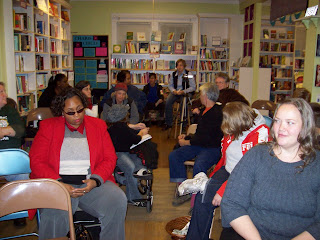
I was also happy that Eleanor and Barb came from Concrete Change, as well as Zan Thornton. It's always good to see long time activists (disability or feminist) mingle with people who are exposed to disability rights activism for the first time, or feminist activism for the first time. Plus, I think the group had more people of color than most other gatherings I have gone to in the last couple of months, so I am very intrigued by Atlanta's possibilities to say the least!
Afterwards I hung out with Bethany and another woman at a bar next door to Charis and talked for a while, which was overall a very nice ending to my Atlanta visit. I'll be thinking of ways to keep the seed growing...
So Tuesday morning, I tooled around till 11, where I was meeting Mia at Ria's Bluebird Cafe. I should make a note to readers that if you're ever in Atlanta, stop by Ria's as they have some very very good food. Anyhow, the reason I wanted to meet with Mia is not just because she directs SPARK, but also because Mia is herself a queer woman of color with a physical disability who is invested in intersectional activism---meaning activism from a standpoint of understanding how race, gender, class, sexuality and other social categories suffer (overlapping) oppression.
Anyhow, plus, my friend Stacey said I really, really had to meet Mia. Stacey writes the Miss Crip Chick blog, which is worth anyone checking out.
As it turns out, Mia is a very, very nice woman who had just been through two back to back conferences. Ouch. We ordered some food (and I screwed up my order through a "deaf moment"---hence the plug of Ria's above) and chatted for about an hour. SPARK is the main reproductive justice organization in Georgia and was formerly known as Georgians for Choice. They educate creatively on reproductive justice and collaboratively coordinate different events---rallies, conferences etc. Mia said that SPARK includes disability in their oppression analysis, which is fantastic and I wish more reproductive choice organizations could follow their lead.
We talked about the role of reproductive justice in the disability rights movement. I mentioned that I feel it's been quashed on the general crip radar because of ethical issues that involve assisted suicide, pre-birth bioethics, and the religious right. The question is, do we as a disability community need to agree on pro-choice/pro-life before we can get women with disabilities mobilized together? Mia felt, and I agree, that just because people have differing views on pro-choice stuff, doesn't mean we can't mobilize women with disabilities on the other issues that affect us. However the choice thing does remain the big pink elephant in the room.
While talking with Mia, I realized that though she doesn't do only disability-specific work, she is familiar with a number of folks I know in the disability community (like Eleanor Smith), which is great. If you are reading this post and you live in Atlanta, please consider looking Mia up to see how her organization's work intersects with your own. I had the impression from talking with her that she's someone who is very progressive and cares a lot about community building. People like Mia and her colleagues are the kind of folks who will help our movement grow.
While we were only able to meet for an hour, I am thankful we did so. Mia also assisted me in trying to contact Project South, because I'd had no luck in contacting them (and sometimes, hearing folks only respond to voice phone calls). Turns out they were pretty much out of the office that day---I'll check in with them in the future. Bummer. But, here is a picture of Mia calling Project South for me:
One other thought about Mia's work: this consciousness of intersection is something that is very important to younger US activists with disabilities. We ARE intersections. From my perspective as a youth leadership coordinator in the disability community, I don't see this as a trend---I think it's actually a direction. And it's not just a direction for the disability community, it's a direction for the US as a whole.
Afterwards, I had pretty much the whole afternoon open, and I was planning to visit the King Center some more, but unfortunately I was coming down with a cold and opted to spend a few hours trying to get some rest. After that and lots of medicine, I prepped for the Charis event over in what I was told was Little Five Points, two minutes away from Druid Hills.
Mark Johnson had directed me to Charis, a non-profit feminist bookstore that coordinates different speaking series and also a review. Kerrie Lynn, who also happens to be on SPARK's board, coordinates a series on disability and feminism, so she and I worked together to arrange a community discussion. I am really thankful to Kerrie and Charis for their support for the event, including finding two interpreters to help me out. I think it was the first time I'd ever done organizing work in a bookstore, so I wasn't sure what to expect, but it turned out really well. Mia wasn't able to make it as she had two (!) meetings that evening, but she was missed! :)
About 15 folks showed up, and initially I gave my spiel about FRIDA and my project, as well as ADAPT and Access Living. Then, I asked people to shout out issues that they thought were important for women with disabilities, and they came up with:
...transportation
...parenting, especially parents rights vs. the state child protective services people
...housing and visitability
...access to health care
...media
...sex (and really this was the first time in my project that a group talked a lot about sex, but I suspect it was because Bethany Stevens was there, and this is her #1 issue of interest!)
So we discussed these issues and how they were affecting women in Atlanta, and I talked about how different sorts of systems control these things---federal, state, local, and even agencies that are not government agencies but exert control over our lives. A lot of women took it on themselves to speak up about different issues, and I pointed out that in case they were wondering what the feminist disability rights movement looks like, it looks like THEM. US. And so we wrapped up the evening by offering an opportunity to maybe start a listserv via email about feminist disability rights activism. So Atlanta did a great job!
Here is a picture of folks at the gathering at Charis:
I was also happy that Eleanor and Barb came from Concrete Change, as well as Zan Thornton. It's always good to see long time activists (disability or feminist) mingle with people who are exposed to disability rights activism for the first time, or feminist activism for the first time. Plus, I think the group had more people of color than most other gatherings I have gone to in the last couple of months, so I am very intrigued by Atlanta's possibilities to say the least!
Afterwards I hung out with Bethany and another woman at a bar next door to Charis and talked for a while, which was overall a very nice ending to my Atlanta visit. I'll be thinking of ways to keep the seed growing...
Good Morning, Readers!
I wanted to take a minute to thank everyone who has been reading the blog and sharing the website address with others. I also wanted you to know who else has been visiting too.
For example, I noticed that in the last two days there was a spike in readership from South Korea, so to whoever is reading from South Korea, thank you! I've also noticed quite a number of readers from Australia, New Zealand and the UK, and I thank all those readers as well---good morning to you all (whatever time zone you're in)!
Since I set up this blog back in September, I've also noticed visits from Lebanon, Finland, Russia, Denmark, Brazil, Canada, the United Arab Emirates (yep, Dubai!) and others. I even noticed someone visiting from Iran, which surprised me given the reported serious Internet censorship of browsers---I understand even searching for a word like "woman" gets blocked. It's rather cool because the Farsi cyber community is one of the largest in the world. Obviously, Farsi rocks. I have not noticed any visitors from Africa except maybe two, but Africa has the lowest density of Internet users in the world.
And of course I must also thank all American visitors and my 26 friends who have subscribed to Ambertracker punishment via e-mail. ;)
I thank you all for your interest in the struggle of women with disabilities and Deaf women, and hope this blog helps gives readers some ideas for taking action! Onward to more posting...
For example, I noticed that in the last two days there was a spike in readership from South Korea, so to whoever is reading from South Korea, thank you! I've also noticed quite a number of readers from Australia, New Zealand and the UK, and I thank all those readers as well---good morning to you all (whatever time zone you're in)!
Since I set up this blog back in September, I've also noticed visits from Lebanon, Finland, Russia, Denmark, Brazil, Canada, the United Arab Emirates (yep, Dubai!) and others. I even noticed someone visiting from Iran, which surprised me given the reported serious Internet censorship of browsers---I understand even searching for a word like "woman" gets blocked. It's rather cool because the Farsi cyber community is one of the largest in the world. Obviously, Farsi rocks. I have not noticed any visitors from Africa except maybe two, but Africa has the lowest density of Internet users in the world.
And of course I must also thank all American visitors and my 26 friends who have subscribed to Ambertracker punishment via e-mail. ;)
I thank you all for your interest in the struggle of women with disabilities and Deaf women, and hope this blog helps gives readers some ideas for taking action! Onward to more posting...
Sunday, November 23, 2008
Shepherd Center. King Center. Shepherd Center. King Center...
Back when I attended my first organizing training ever (right after Hurricane Katrina hit New Orleans, as I recall), I remember that our trainers posed the following question to fifteen of us trainees from around the Midwest: was Martin Luther King a leader or an organizer?
I recall thinking that Dr. King did a lot of the vision work, but the folks who got the grassroots to turn out by the hundreds and thousands were the real organizers. Nobody knows the name of whoever said, “Let’s boycott the buses in Montgomery---what resources do we have?” Civil rights grassroots wins happened in large part because of the nameless many church folks and the community groups---they were the organizers of people and time and money, and Dr. King was best at empowering the many to find words for their one cause, because ultimately he spoke from his heart as a leader.
In Atlanta, not only was I lucky enough to meet with Eleanor (who I think balances both organizing and leadership), but I also spent the afternoon of Monday, November 17, with Mark Johnson, a disability rights organizer with ADAPT since the early 1980s and Advocacy Director for the Shepherd Center. In addition to talking disability shop, Mark also took me over to visit the Dr. Martin Luther King Center. Back when I was planning this trip, Mark actually ASKED why my original itinerary did not include Atlanta, so it’s really thanks to Mark being a squeaky wheel that I ended up here.
So I Mapquested my way over to the Shepherd Center, which is a spinal cord, traumatic brain injury and multiple sclerosis rehab center. The Shepherd Center was founded back in the 1980s, at a time when there was no real rehab center for spinal cord injuries in the South back then. For a rehab center, I like that it resists the institutional bias to a degree with progressive programs like a gym that is open to the public, not just patients. It also has a Bridge program where counselors follow the progress of each patient for one year after they leave the Shepherd Center, in order to ensure the patients achieve real reintegration into their communities and aren’t just dumped off once the docs are done patching up their spines. Plus, Shepherd has a women’s peer support group that meets once a month, and Mark introduced me to its coordinator, Minna Hong, who is an awesome woman in her own right and with whom I hope to work more with in the future.
Mark himself has been a quad since the age of twenty (he pointed out that SCI is a male-dominated disability). As Advocacy Director for Shepherd, Mark keeps track of local and federal legislation, as well as issue trends. In addition, he connects people and groups with decision makers to create change. In short, he is an organizer. Read more about him here.
In the course of our conversation, Mark uncovered that I’d somehow (amazingly) forgotten to make plans to go visit the Martin Luther King Center. I couldn’t believe it. I think I got majorly distracted while blitzing from Sydney to Wellington to Sydney to San Francisco to Berkeley to Phoenix to Atlanta in something like five days. So Mark offered to take me over and have a look at some sights in Atlanta as well as the King Center, and we hopped in his van and went.
Our first stop was over near the CNN headquarters at Atlanta’s central plaza, where believe it or not ADAPT has a brick in the pavilion. Here’s a picture...look for the brick that says ADAPT USA:

We then zoomed past various buildings of ADAPT interest, and past the Georgia state legislature building (the Georgia state legislature is in session three months of the year, in case you were wondering over there in Texas where your state legislature is in town two months once every two years!). The King Center is within easy driving distance of the city center, with Dr. King’s boyhood home, tomb, the two Ebenezer Baptist Churches, the Center for Nonviolent Social Change and the actual King Center itself all within two or three blocks on Auburn Street.
At this point Mark informed me---not without a gleam in his eye---that right next door to the King Center is nothing other than a NURSING HOME! I thought he was kidding me, but nope, saw it with my own eyes and here it is, Parkview Manor:

Just another nursing home, right across the street from Dr. King’s tomb. Do you really think the world would have let Dr. King himself live in a nursing home? I don’t think so! If we wouldn’t have liked it for Dr. King, why should it be ok for anyone else?
Mark dropped me right off at the King Center because it was closing in about fifteen minutes, and when I ran in I found myself right at a life size model of marchers, one of whom is an amputee, as seen in the photo below:

I wandered around a little bit, and then Mark came in from parking the van and asked if I’d seen the marchers---yep, especially the amputee one? Good to see crips representing! As the museum then announced it was closing, he took me over to Dr. and Mrs. King’s white marble tomb, which is situated in the middle of a reflecting pool. Dr. King’s epitaph, in his own words, reads, “Free at last, Free at last, Thank God Almighty, I’m free at last.” Mrs. King’s epitaph reads, “And now abide Faith, Hope, Love, These Three; but the greatest of these is Love.” Here is a picture:

Then we took a look at the Eternal Flame by the tomb site. And here is a picture of Mark zooming off in the direction of the old Ebenezer Baptist Church:

Well, visiting the King complex reminded me that I've visited the Lincolns' grave in Springfield, Illinois, and the graves of the Kennedys at Arlington, not to mention Emma Goldman and Mother Jones. And you know what I think? I think that even though the disability rights movement has suffered so many passings itself, I am grateful that our movement is alive and growing after over forty years, and that we younger folks have the benefit of guidance from people like Mark, as well as Bob and Stephanie and Peg and Marsha and Rosemary and Mike E. and Nadina and Laura and Robin and Eleanor and a whole bunch of living, breathing people who fight hard and care deeply.
The movement may not in the future look as it has looked in the past, but as we see laws defeated and narrowed by the courts, and as greater and greater numbers of young people pass through the public education system and fail at basic independence despite society's promises of empowerment, and as we die and suffer under our current health care system, people with disabilities will continue to find new, renewed opportunities for making change together. We do, however, have to work conscientiously---fighting for women as well as men, as well as trans people. Perhaps thinking about a movement is what makes it so...if that's the case, then I at least intend to keep my faith in the varied abilities of my friends and colleagues who work for the cause, of all genders, of all perspectives, of all origins.
I recall thinking that Dr. King did a lot of the vision work, but the folks who got the grassroots to turn out by the hundreds and thousands were the real organizers. Nobody knows the name of whoever said, “Let’s boycott the buses in Montgomery---what resources do we have?” Civil rights grassroots wins happened in large part because of the nameless many church folks and the community groups---they were the organizers of people and time and money, and Dr. King was best at empowering the many to find words for their one cause, because ultimately he spoke from his heart as a leader.
In Atlanta, not only was I lucky enough to meet with Eleanor (who I think balances both organizing and leadership), but I also spent the afternoon of Monday, November 17, with Mark Johnson, a disability rights organizer with ADAPT since the early 1980s and Advocacy Director for the Shepherd Center. In addition to talking disability shop, Mark also took me over to visit the Dr. Martin Luther King Center. Back when I was planning this trip, Mark actually ASKED why my original itinerary did not include Atlanta, so it’s really thanks to Mark being a squeaky wheel that I ended up here.
So I Mapquested my way over to the Shepherd Center, which is a spinal cord, traumatic brain injury and multiple sclerosis rehab center. The Shepherd Center was founded back in the 1980s, at a time when there was no real rehab center for spinal cord injuries in the South back then. For a rehab center, I like that it resists the institutional bias to a degree with progressive programs like a gym that is open to the public, not just patients. It also has a Bridge program where counselors follow the progress of each patient for one year after they leave the Shepherd Center, in order to ensure the patients achieve real reintegration into their communities and aren’t just dumped off once the docs are done patching up their spines. Plus, Shepherd has a women’s peer support group that meets once a month, and Mark introduced me to its coordinator, Minna Hong, who is an awesome woman in her own right and with whom I hope to work more with in the future.
Mark himself has been a quad since the age of twenty (he pointed out that SCI is a male-dominated disability). As Advocacy Director for Shepherd, Mark keeps track of local and federal legislation, as well as issue trends. In addition, he connects people and groups with decision makers to create change. In short, he is an organizer. Read more about him here.
In the course of our conversation, Mark uncovered that I’d somehow (amazingly) forgotten to make plans to go visit the Martin Luther King Center. I couldn’t believe it. I think I got majorly distracted while blitzing from Sydney to Wellington to Sydney to San Francisco to Berkeley to Phoenix to Atlanta in something like five days. So Mark offered to take me over and have a look at some sights in Atlanta as well as the King Center, and we hopped in his van and went.
Our first stop was over near the CNN headquarters at Atlanta’s central plaza, where believe it or not ADAPT has a brick in the pavilion. Here’s a picture...look for the brick that says ADAPT USA:
We then zoomed past various buildings of ADAPT interest, and past the Georgia state legislature building (the Georgia state legislature is in session three months of the year, in case you were wondering over there in Texas where your state legislature is in town two months once every two years!). The King Center is within easy driving distance of the city center, with Dr. King’s boyhood home, tomb, the two Ebenezer Baptist Churches, the Center for Nonviolent Social Change and the actual King Center itself all within two or three blocks on Auburn Street.
At this point Mark informed me---not without a gleam in his eye---that right next door to the King Center is nothing other than a NURSING HOME! I thought he was kidding me, but nope, saw it with my own eyes and here it is, Parkview Manor:
Just another nursing home, right across the street from Dr. King’s tomb. Do you really think the world would have let Dr. King himself live in a nursing home? I don’t think so! If we wouldn’t have liked it for Dr. King, why should it be ok for anyone else?
Mark dropped me right off at the King Center because it was closing in about fifteen minutes, and when I ran in I found myself right at a life size model of marchers, one of whom is an amputee, as seen in the photo below:
I wandered around a little bit, and then Mark came in from parking the van and asked if I’d seen the marchers---yep, especially the amputee one? Good to see crips representing! As the museum then announced it was closing, he took me over to Dr. and Mrs. King’s white marble tomb, which is situated in the middle of a reflecting pool. Dr. King’s epitaph, in his own words, reads, “Free at last, Free at last, Thank God Almighty, I’m free at last.” Mrs. King’s epitaph reads, “And now abide Faith, Hope, Love, These Three; but the greatest of these is Love.” Here is a picture:
Then we took a look at the Eternal Flame by the tomb site. And here is a picture of Mark zooming off in the direction of the old Ebenezer Baptist Church:
Well, visiting the King complex reminded me that I've visited the Lincolns' grave in Springfield, Illinois, and the graves of the Kennedys at Arlington, not to mention Emma Goldman and Mother Jones. And you know what I think? I think that even though the disability rights movement has suffered so many passings itself, I am grateful that our movement is alive and growing after over forty years, and that we younger folks have the benefit of guidance from people like Mark, as well as Bob and Stephanie and Peg and Marsha and Rosemary and Mike E. and Nadina and Laura and Robin and Eleanor and a whole bunch of living, breathing people who fight hard and care deeply.
The movement may not in the future look as it has looked in the past, but as we see laws defeated and narrowed by the courts, and as greater and greater numbers of young people pass through the public education system and fail at basic independence despite society's promises of empowerment, and as we die and suffer under our current health care system, people with disabilities will continue to find new, renewed opportunities for making change together. We do, however, have to work conscientiously---fighting for women as well as men, as well as trans people. Perhaps thinking about a movement is what makes it so...if that's the case, then I at least intend to keep my faith in the varied abilities of my friends and colleagues who work for the cause, of all genders, of all perspectives, of all origins.
Subscribe to:
Posts (Atom)

 Posts
Posts


