Sunday, November 23, 2008

Shepherd Center. King Center. Shepherd Center. King Center...

Back when I attended my first organizing training ever (right after Hurricane Katrina hit New Orleans, as I recall), I remember that our trainers posed the following question to fifteen of us trainees from around the Midwest: was Martin Luther King a leader or an organizer?

I recall thinking that Dr. King did a lot of the vision work, but the folks who got the grassroots to turn out by the hundreds and thousands were the real organizers. Nobody knows the name of whoever said, “Let’s boycott the buses in Montgomery---what resources do we have?” Civil rights grassroots wins happened in large part because of the nameless many church folks and the community groups---they were the organizers of people and time and money, and Dr. King was best at empowering the many to find words for their one cause, because ultimately he spoke from his heart as a leader.

In Atlanta, not only was I lucky enough to meet with Eleanor (who I think balances both organizing and leadership), but I also spent the afternoon of Monday, November 17, with Mark Johnson, a disability rights organizer with ADAPT since the early 1980s and Advocacy Director for the Shepherd Center. In addition to talking disability shop, Mark also took me over to visit the Dr. Martin Luther King Center. Back when I was planning this trip, Mark actually ASKED why my original itinerary did not include Atlanta, so it’s really thanks to Mark being a squeaky wheel that I ended up here.

So I Mapquested my way over to the Shepherd Center, which is a spinal cord, traumatic brain injury and multiple sclerosis rehab center. The Shepherd Center was founded back in the 1980s, at a time when there was no real rehab center for spinal cord injuries in the South back then. For a rehab center, I like that it resists the institutional bias to a degree with progressive programs like a gym that is open to the public, not just patients. It also has a Bridge program where counselors follow the progress of each patient for one year after they leave the Shepherd Center, in order to ensure the patients achieve real reintegration into their communities and aren’t just dumped off once the docs are done patching up their spines. Plus, Shepherd has a women’s peer support group that meets once a month, and Mark introduced me to its coordinator, Minna Hong, who is an awesome woman in her own right and with whom I hope to work more with in the future.

Mark himself has been a quad since the age of twenty (he pointed out that SCI is a male-dominated disability). As Advocacy Director for Shepherd, Mark keeps track of local and federal legislation, as well as issue trends. In addition, he connects people and groups with decision makers to create change. In short, he is an organizer. Read more about him here.

In the course of our conversation, Mark uncovered that I’d somehow (amazingly) forgotten to make plans to go visit the Martin Luther King Center. I couldn’t believe it. I think I got majorly distracted while blitzing from Sydney to Wellington to Sydney to San Francisco to Berkeley to Phoenix to Atlanta in something like five days. So Mark offered to take me over and have a look at some sights in Atlanta as well as the King Center, and we hopped in his van and went.

Our first stop was over near the CNN headquarters at Atlanta’s central plaza, where believe it or not ADAPT has a brick in the pavilion. Here’s a picture...look for the brick that says ADAPT USA:

ADAPT USA pavement brick

We then zoomed past various buildings of ADAPT interest, and past the Georgia state legislature building (the Georgia state legislature is in session three months of the year, in case you were wondering over there in Texas where your state legislature is in town two months once every two years!). The King Center is within easy driving distance of the city center, with Dr. King’s boyhood home, tomb, the two Ebenezer Baptist Churches, the Center for Nonviolent Social Change and the actual King Center itself all within two or three blocks on Auburn Street.

At this point Mark informed me---not without a gleam in his eye---that right next door to the King Center is nothing other than a NURSING HOME! I thought he was kidding me, but nope, saw it with my own eyes and here it is, Parkview Manor:

Exterior of Parkview Manor, a nursing home

Just another nursing home, right across the street from Dr. King’s tomb. Do you really think the world would have let Dr. King himself live in a nursing home? I don’t think so! If we wouldn’t have liked it for Dr. King, why should it be ok for anyone else?

Mark dropped me right off at the King Center because it was closing in about fifteen minutes, and when I ran in I found myself right at a life size model of marchers, one of whom is an amputee, as seen in the photo below:

Life size display of mannequins dressed as marchers in a civil rights demonstration

I wandered around a little bit, and then Mark came in from parking the van and asked if I’d seen the marchers---yep, especially the amputee one? Good to see crips representing! As the museum then announced it was closing, he took me over to Dr. and Mrs. King’s white marble tomb, which is situated in the middle of a reflecting pool. Dr. King’s epitaph, in his own words, reads, “Free at last, Free at last, Thank God Almighty, I’m free at last.” Mrs. King’s epitaph reads, “And now abide Faith, Hope, Love, These Three; but the greatest of these is Love.” Here is a picture:

The white double tomb of Dr. and Mrs. King in the blue reflecting pool

Then we took a look at the Eternal Flame by the tomb site. And here is a picture of Mark zooming off in the direction of the old Ebenezer Baptist Church:

Viewed from the back, Mark goes towards Ebenezer Baptist Church across the street from the King Center

Well, visiting the King complex reminded me that I've visited the Lincolns' grave in Springfield, Illinois, and the graves of the Kennedys at Arlington, not to mention Emma Goldman and Mother Jones. And you know what I think? I think that even though the disability rights movement has suffered so many passings itself, I am grateful that our movement is alive and growing after over forty years, and that we younger folks have the benefit of guidance from people like Mark, as well as Bob and Stephanie and Peg and Marsha and Rosemary and Mike E. and Nadina and Laura and Robin and Eleanor and a whole bunch of living, breathing people who fight hard and care deeply.

The movement may not in the future look as it has looked in the past, but as we see laws defeated and narrowed by the courts, and as greater and greater numbers of young people pass through the public education system and fail at basic independence despite society's promises of empowerment, and as we die and suffer under our current health care system, people with disabilities will continue to find new, renewed opportunities for making change together. We do, however, have to work conscientiously---fighting for women as well as men, as well as trans people. Perhaps thinking about a movement is what makes it so...if that's the case, then I at least intend to keep my faith in the varied abilities of my friends and colleagues who work for the cause, of all genders, of all perspectives, of all origins.

The Feminist Argument for Visitability

Most folks have no clue what “visitability” means, and the American building industry would like to keep things that way. And yet visitability is THE clear architectural expression of real community building, real breakdown of environmental paternalism, and a tangible weapon in eliminating class barriers. Visitability should absolutely have a home on the feminist disability rights policy agenda.

What is visitability? Well, last Monday, November 19, I met with the woman who came up with the idea back in 1988. Eleanor Smith was an ADAPT activist helping to fight for accessible buses back then, and one day she had an idea, which was: what if all HOMES were accessible? And what if federal, state and local regulations could make them so?

Visitability, as conceived by Eleanor and the people at her organization, Concrete Change, is the idea that all new homes should have three things: one zero-step entrance at the front, side or back of the home; a bathroom or half bathroom on the entry level; and at least 32 inches of clearance on interior doors. Simple. If a builder does this when building a home, not only does it save thousands of dollars on later modifications for physical impairments, but it does the following:

• Provides more housing options for women with disabilities who must escape a violent/abusive living environment *FAST*
• Saves single women and mothers from potential financial ruin due to the cost of modifications, should a member of the household become physically disabled
• Allows all people to actually visit one another’s homes, to go trick or treating or have a party or check out your child’s playmate’s home---ending social isolation, the number one foe of women and girls with disabilities

Visitability does not mean building fully accessible homes, but it improves the social flow of who is able to actually go into each others’ homes. As an ADAPTer I have heard several women with disabilities say that they don’t know their neighbors because their neighbor has one step at every entrance to their home. One step.

So why do builders hate the whole visitability thing? Good question. When Concrete Change has been able to have talks with individual builders, the builders often are open minded to the idea of visitability. Concrete Change actually partnered with Habitat for Humanity Atlanta to build 800 visitable homes in the area, to date. People like the mother whose son got shot, became a paraplegic, and came to live with his mother are extremely grateful for the visitable features.

And, Eleanor and two collaborators published an article in the summer 2008 edition of the Journal of the American Planning Association titled “Aging and Disability,” which demonstrated that over the lifetime of an American house, there is a 60% chance that that house will have a resident with a disability. The article is fantastic and has gotten almost zero buzz. What is going on?

It seems that really, the problem is that builders just wanna build what they wanna build. According to the JAPA article, “Visitability legislation is controversial because it raises issues regarding the individual rights of property owners, the civil rights of disabled persons, and the proper role of government.” Builders have contested and continue to contest every ordinance (in Atlanta, San Antonio, Chicago, Lafayette CO and the states of Georgia, Texas and Kansas). The National Association of Home Builders isn’t down with visitability. I guess they like making stairs... Well really, I see it as a problem of perception.

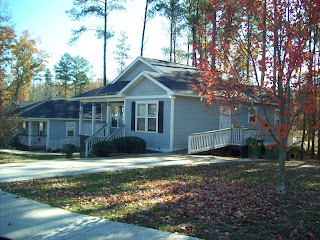
And yet I see that visitability works, as clear as day, when Eleanor took me around the housing development where she herself lives, where all the homes are visitable. I can see for my own self that everyone, from little tiny crip kids to really old folks, can get in and out of these homes, even though it’s built on a combination of flat and hilly lots. It is a regular type of housing development with toys and plants and autumn leaves scattered around.

And I can see the visitability just as clearly when Eleanor took me over to a Habitat development, also on both hilly and flat lots. Worried about a slope? Put the driveway at the tope of the grade and have the accessible entrance be on that side. Worried that the houses will be ugly? These homes are cute and if they do have ramps, the ramp is integrated in the design. I would personally love to be able to live in such a development with my disability community friends and have us be able to visit each other all the time. Here is a picture of a Habitat home built on a slope:

Blue and white Habitat home with a driveway and ramp built on a slope

I think that not to use visitability in home design cheats America, and in particular it cheats women.

There is policy designed to mandate visitability across the US, and it is called the Inclusive Home Design Act, first introduced in 2003 by Representative Jan Schakowsky of Illinois. This bill would require a zero-step entrance, 32 inches of clearance for doorways on the main floor, and a bathroom that can accommodate wheelchairs in all new single-family homes built using federal dollars. Note the using federal dollars bit---it doesn’t cover homes built using entirely money.

So while I know that right now, folks are scared about the economy and jobs, and that polticians are going to be full-frontally focused on that for quite a while, I urge feminists with and without disabilities to put visitability and measures such as the Inclusive Home Design Act on your agenda. Do this not only for people with disabilities and seniors, but for all women. Talk to anyone you know who is building a home or homes, and explain how they can make the world better for women by using three simple concepts.

Many thanks and warm wishes to Eleanor and Barb and Concrete Change in their work, and particularly thank you to Eleanor for your time in educating me (and recommending a play to stay while in Atlanta!). Here is a picture of Eleanor in front of a visitable home, holding up the ADAPT DUHcity action tshirt (our last action was about housing):

Eleanor Smith holding up a green ADAPT t-shirt in front of a condo house with autumn leaves on the sidewalk


****


In closing, I would also like to dedicate this post to disability rights activist Ricki Landers, who passed away a week ago. Ricki was a warrior with Salt Lake City ADAPT and such a tough woman that she once held up an entire intersection on her own in her struggle to free her ex-husband from a nursing home. Ricki, your scratchy voice and your drive will be missed, and I will always remember your yelling at the cops to COMMUNICATE with me in front of the state legislature in Nashville. FREE OUR PEOPLE!

Thursday, November 20, 2008

News from Arizona

Hi folks, currently I am in the warm and sunny southeastern part of Arizona taking a much needed working break with family in these parts. Until November 29, I will be catching up with posting about Australia, a bit more about New Zealand, and then also on Atlanta, where we at Charis had a fabulous time---and I also had fabulous one on one meetings with Eleanor, Mark and Mia. Pictures will be posted around November 29 because I'm working from a dial up connection which is too slow to handle picture posting.

At this point I've flown 22 flights as part of this project and fear I may be developing an allergy to airlines... well, I'll get over that but it is quite a lot of flying. I also came down with a cold the last couple of days, so it's just as well I'm away from most of civilization at the moment. I do very much appreciate the messages of support I have received via e-mail and it is very inspiring to see how much people support the advancement of advocacy by and for women with disabilities. It is so so cool. I am amazed by all my hosts' generosity in things like feeding and housing me, which helps me stretch my grant just that much farther to do more work with more women.

I think perhaps I am also in existential crisis mode. As in: having seen so many "homes" of the disability community, and such different kinds of work going on in so many places, and such enthusiasm with so many warm and hard working people, where the hell do I want to be and work (and live---I'm terrible about forgetting "me" time)? Yes, Chicago is my home right now, but also I realize that the disability community is everywhere---and that the number one mechanism women with disabilities need right now is some kind of way to stay connected and organized. So what is the best way to do this, in a way that empowers all of us and isn't all about me being everywhere? Comment or email with ideas!

Monday, November 17, 2008

PWD, SPRC and Fe Fes in Sydney

Tuesday, November 11 was a busy day. In the morning, I visited with People with Disability (PWD); in the afternoon, with the Social Policy Research Center (SPRC) at the University of New South Wales; and in the evening Sharon hosted a "meet and mingle" at her house for women with disabilities to gather and watch the entire series of the Fe Fe movies!

At PWD, I met with co-director Therese Sands and four members of the advocacy team, including Denise Beckwith. My colleague at Access Living, Kim Borowicz, used to be an intern here, so Kim, PWD says HI! Anyway, PWD engages in both individual and systems advocacy, and also does litigation. In this sense, the organization reminds me of a Protection and Advocacy agency in the US. However, PWD is a coalition of disability organizations and people with disabilities, and in Australian parlance, it is a “peak” organization. I believe this means it’s at the top of the network hierarchy.

One of the first areas of concern we addressed was deinstitutionalization, a major area of work for PWD. Therese said that while Australians have fought for years for the government to end the institutional bias, these days they are seeing a new trend back towards reinstating that bias. In other words, funding for community integration is being cut or not matched by state governments, and the size of group homes recently increased from 3 to 5 residents. PWD is fighting to stop these efforts.

The PWD team also gave me the basics on boardinghouses. Boardinghouses are for-profit private businesses that house people with disabilities who need minimal supports, such as a routine doling out of meds. In exchange for these minimal supports, residents get a bed in a shared room to sleep. Boardinghouses house between four and 105 residents, and cost between 85% and 100% of a resident’s Disability Support Pension (DSP), which is the Oz version of SSI. Boardinghouses have been known to use chemical restraints, as well as financial, psychological and physical abuse. PWD’s position is that boardinghouses should close, with no licensing of any new boardinghouses. Basically boardinghouses smell a lot like nursing homes or some ICF-MRs.

I asked about PWD’s avenues of advocacy, and they tend to work though the directors-general or ministers of different agencies, or meetings with political officials such as leaders of the opposition party in Parliament. On occasion there will be Parliamentary inquiries into issues affecting people with disabilities, and PWD will testify. Members of Parliament don’t really represent a constituency in the manner we are used to in the US, however---the way to influence MP is to control party politics.

Back to boardinghouses---in the state of New South Wales, there are 45 boardinghouses with a conservative estimate of 1,000 residents. PWD began getting involved with deinstitutionalization in 2001 or so, because there were boardinghouse closures and PWD was assisting individuals in the transition process. As it turned out, PWD uncovered a lot of abuse and intimidation and was motivated to pursue systems advocacy.

Disability and parenting is another issue of concern at PWD, especially lack of parental support when either the children or parents have a disability. PWD is also concerned about kids with disabilities who just get left in facilities because their parents can’t figure out how to care for them. So they work with individual families to help them navigate systems. For parents who have psychiatric or intellectual disabilities, the state will label them during their pregnancy. Because the parents are labeled high risk, the state may attempt to take the children away. There is an over-representation of these types of disabilities in parents involved in the state child care system.

A slight digression---I asked the team about their volume of clients. Denise Beckwith, who handles intake, says she gets about 40-50 calls a week from the main line, and there is an active list of about 200 clients.

Another of advocacy PWD addresses is home modifications---which I personally have to say looks like a nightmare given the age and small proportions of so many buildings in the Sydney area.

I then asked about PWD work that specifically has affected women with disabilities. They have had a project on sexual assault, and have done work to prevent domestc violence. There are no women’s support services in NSW that are accessible for women with disabilities. PWD has worked with the women’s field sector on CEDAW, which process allowed for inclusion and education on disability. PWD has a new effort they are working on to train women on their rights, so hopefully we will be hearing more about that good work soon. The team also mentioned that in the past they have done strong anti-sterilization advocacy, raising the profile of that issue in the human rights sector.

The final part of our conversation was on multiculturalism and diversity. PWD is co-working with Aboriginal peoples and about 20 to 25% of the consumers are Aboriginal. Many others are from Asia or Pacific Islander groups. PWD has also worked in the past with the LGBTQ community, for example helping to identify legislation that would affect LGBTQ people with disabilities. They do not exactly serve Deaf people but have a working referral relationship with the Deaf Society of NSW. PWD focuses on cross-disability work but will support other groups with a specific-disability focus.

With Aboriginal peoples, the point I was advised to remember is that there are many Aboriginal groups with a lot of diversity. There usually isn’t a word for “disability” or disability is not recognized. There is a great need for education among Aboriginal folks on what disability means, and also among for examplemedical professionals serving Aboriginal peoples because the med folks don’t really understand how to handle disability either. Disability services for Aboriginal people are still very, very new.

At this point, we ended the meeting and I took a pic of the team, which I will post at the end of this month when I am not using dial-up from rural Arizona. I then went off to eat lunch with Sharon, her sister in law and Sharon’s niece. While hanging out with them I found a brand new pair of pink sparkly Converse shoes, which was great because my old silver ones were cracking apart. Unfortunately lunch took a bit longer than we expected and Sharon and I were a bit late getting over to SPRC to meet with Karen Fisher and her colleagues.

The SPRC meeting was, I think, the first one that I’d had in a specifically academic setting. As an activist, I’m aware that quite often researchers and activism go very well together, and at other times they have a falling-out. SPRC research has assisted groups like PWD to prove their case before the government. Getting the numbers on disability discrimination is critical. Anyway, Sarah Parker, a disability studies professor at the University of Illinois at Chicago (who happens to be from Australia), recommended I meet with Karen Fisher and the SPRC bunch, so we set it up. Karen met me with three of her colleagues, one of whom worked on PWD’s sexual violence project, so that was very cool. In addition Karen herself has done research on women and disability and it was a pleasure to talk with her. Her other two colleagues have done more work on young people and disability, especially assisting parents of children with autism to navigate services, which is an incredibly important job. The following day, I was to meet with Helen Meekosha and Leanne Dowse, so I tabled some of my questionson sexism and disability until then (unfortunately, that meeting fell through especially as Helen was sick). But I was very interested to learn about disability research being INCLUDED under a general social policy research agenda! See, THAT’s how academic priorities should work---disability should ALWAYS be at the table. Many thanks to Duncan Aldridge for helping to coordinate all of this.

Finally, and I know this is turning into a verrrry long post, Sharon and I shopped for goodies for a showing of the Fe Fe movies at Sharon’s home. She had organized a bunch of her friends and colleagues to come over and I think we had about eight or nine people come overall. And so we ordered LOTS of pizza and watched all three of the videos! And then we topped it off with tea and Lamington cakes (go Google that!). What did the group think of the videos? Well, they liked that the Fe Fes address a lot of topics that would normally be considered taboo (like, uh, well, how to put a condom on with your mouth). They also liked the street scenes and the realness of the film. One feedback was that perhaps the films could be edited to be more inclusive of people with cognitive/intellectual disabilities. Good point, and something for consideration for any film. I thought it was a terrific way overall to cap off my last evening in Sydney!

Sydney: Disability at Australian City and State Levels

On Monday, November 10, Sharon helped arrange for me to meet with Glenn Redmayne and Dougie Herd. Glenn is the Disability Worker for Marrickville City Council, while Dougie directs the Disability Council of New South Wales. While neither Glenn nor Dougie specifically focus on women with disabilities (although it is an area that Dougie’s office addresses), I wanted to get a sense of Australian disability systems advocacy and maybe some insights on community dynamics.

Sharon dropped me off at Glenn’s office in the morning, which is situated in a 1930s Art Deco style complete with a clock tower and a ball room, not to mention an old fashioned coat check in the ladies’ room. Glenn turned out to be a ponytailed guy with a physical disability who uses a wheelchair, and we met in the Amenities Room, which was nice and quiet for me (except for when planes blasted by overhead due to the building being in the Sydney Airport flight corridor).

Marrickville City Council administers several neighborhoods in the Sydney area, such as Petersham, Dulwich Hill, etc. Glenn’s job is to help get the city to be inclusive of disability perspective in its projects, for example working on transportation or other forms of community development. In addition he helps educate community organizations about disability. The Council has twelve elected members. The Council does not focus on individual case work for people with disabilities, but if an individual comes to Council workers with a problem, they refer them as best as they can. The Council’s area is in a very old and often cramped part of town, so one issue has been making things accessible when buildings have been existing for decades.

I asked Glenn about what he thought about the Disability Discrimination Act (DDA). He pointed out that the DDA is structured so that an individual must produce a really solid case of disability discrimination before the court in order for any action to take place. Instead of having built in pre-emptive standards as the ADA does, the DDA forces individual cases to set standards, but it’s a long shot for most people to build a legally viable complaint case. It’s good that there is a complaint mechanism, but the burden of proving a solid case really weighs heavily on the individual bringing the complaint. However if a complaint does make its way through the court and discrimination is found to have reasonably occurred, then the court’s decision in that case will set a precedent. Sure seems like a long and roundabout way to make change---granted, I’m super impatient.

Glenn also said that City Councils tend to vary in their quality of workers and services provided, so that disability access work is not standardized across Councils. There can be not only variations from town to town, but regional, rural or urban variations as well.

We also remarked on the “tall poppy” situation. I’d previously read that there was a stereotype that Australians make a national sport out of “cutting down the tall poppy;” that is, cutting anyone down to size who is either full of crap or dares to be too different. Glenn agreed that he thought it could be quite an issue at times and we discussed whether in fact the tendency to denigrate anyone who takes risks or does new things is actually detrimental to the disability community, insofar as it is so critical to build creative leadership.

My overall impression of the role of City Councils for disability in Australia is that they afford an opportunity for community education and partnership, while having somewhat limited powers at times (such as not having any jurisdiction with schools for example). I also got the impression that Glenn, and others that I met, would like to see greater development of leadership and greater freedom for individuals to break barriers and make change, but that this is a cultural struggle. I had a very good time discussing these issues with Glenn and was only sorry that I had to move on to my next meeting afterwards. Thank you Glenn!

After scaring up some lunch in Marrickville (did you know Australia has a HUGE cafe culture??) and riding the bus all on my own back to Sharon’s house (and getting sunburned---the sun here is very strong), Sharon and I headed over to Dougie’s office building near the Central train station in Sydney. The Disability Council of NSW is the official group that provides policy recommendations on disability to the state government. It has several member organizations. Dougie himself is a wheelchair user and is originally from Scotland. I think several people were anxious as to whether I would actually understand Dougie’s accent, but we did pretty well as we stayed in his quiet office.

Here is the stunning thing about the Disability Council: take a look at its Board of Directors. It is unusually culturally diverse for a disability rights group with a large chunk of people from non-Anglo backgrounds. Not to mention, they have lots of folks with disabilities on the board. Very awesome! I asked Dougie how long there had been a diversity effort on the board and he said pretty much since he came on board a few years ago. Dougie himself, as it turns out, used to be an anti-apartheid activist back when he lived in Scotland and believes deeply in equality among all people.

Also, I love that the Council has developed policy portfolios on many different issues and a lot of these are online, which helps to build transparency in advocacy work. Very excellent. I asked Dougie about the DDA as well, and he highlighted the fact that a person with a disability needs money to file a legal complaint using the DDA and to pursue it through the court system. The DDA is thus only usable by those with funds.

We also discussed the overall picture of the Australian disability "community." In Australia, most of the population is concentrated in the cities, which are usually on the coast. Geographically, these urban centers are far apart from each other, so a major obstacle towards a national disability community is the difficulty in physically travelling between places. This leads to a more fragmented disability picture.

In addition, disability as a topic of national discourse tends to be dominated by the disability sector, those working in fields serving people with disabilities. The disability "community" itself does not in fact dominate discussions about disability. It is difficult to build a sense of grassroots community not only because of physical distance, but also because there is no sense of shared history as a community and no grassroots movement emphasizing change. Part of the reason there is no grassroots movement, as well, is due to the aforementioned "cutting down the tall poppy" issue, as well as people not liking to ask for help.

To me, this is different than the US, where we have a well established and shared view of a disability history, which we are working to teach our young people. We also have more people with disabilities who are physically closer to each other, as well as a network of over 500 CILs or ILCs nationwide which serve as disability-run gathering points for the disability community. Also, we have a lot of advocates who adhere to the saying "nothing about us without us" and actively seek to make the disability voice heard on every issue that impacts us.

I found it incredibly useful to speak with both Glenn and Dougie on these points, because somehow there's nothing like comparing systems to help one realize what is and is not working in one's own community. Many thanks to Glenn and Dougie, and Sharon as well, for educating me.

Sunday, November 16, 2008

Grilled Cheese in Atlanta---Oh, and a Plug

A quick update---I made it to Atlanta after stopping for around 18 hours in Berkeley, California. I'm currently parked on a couch in the lobby of my hotel next to a sleeping black cat, after having eaten a grilled cheese sandwich and fries around the corner. I've now completed 20 plane flights for this project so far and flying is getting a bit old, although I'm excited about tooling around Atlanta.

Random thoughts related to travel:

Did you know koalas grunt? Apparently they were keeping folks awake at the retreat in Port Stephens---I didn't hear anything because I take my hearing aids out at night. The next morning people were complaining about the koalas.

Did you know the candy Turkish Delight can set off TSA monitors? This happened back at the Oakland airport this morning. I was surprised....but then again it's a rose-flavored jelly candy covered in chocolate. It's popular enough in Australia, as is Violet Crumble. I had fun trying new candies there.

Did you know New Zealand women were able to vote back in 1893? Maori men were also voting by then as well. In contrast, Australia did not grant Aboriginal peoples citizenship until 1967! Women could vote in Australia in 1908 though, years before the US got around to it.

Oh, one other thing---if you are in the Atlanta area, come visit with me at the Charis Circle on Tuesday at 7 pm, where I will be talking about feminist disability rights organizing. Charis Circle is at 1189 Euclid Avenue NE, Atlanta and they are being very nice about hosting this event. Thanks to Kerrie and staff!

Friday, November 14, 2008

Open Spaces in New Zealand

Today, the main thrust of the CCS Disability Action conference agenda was to do Open Space meetings, which are a kind of workshop setting where participants themselves suggest and host informal conversations on different topics, which are assigned different times and spots in the conference area. This was pretty cool as anyone at all could suggest something and interested people just congregate at the place and time. I thought it was a really good way to break down paternalism. In the end over 30 conversations were held today alone, with more scheduled for tomorrow (though unfortunately I will be in the process of flying to San Francisco).

I did have two interpreters today, the one from yesterday and a different one who was much less familiar with ASL---but both were really good sports about it all and it was fun to exchange ASL and NZSL signs. Thanks to Alan and Bridget and to Carol for finding them!

After doing some frantic morning shopping for NZ stuff to take home, I participated in...

....a discussion about developing Maori disability leadership
...a discussion about women's disability rights in New Zealand (the US and NZ share many concerns but primarily women need to think more critically and be more proactive about women's disability rights....some good ideas were bandied about for keeping women with disabilities informed about work that connects them)
...a discussion about disability rights in different countries

All of these talks were pretty fabulous in that I learned things at each one, though perhaps from a different perspective as an American disability rights activist and as a deaf person. I had the impression that CCS Disability Action folks are very much finding their way in a country where PC-ness is valued and people are very nice. We had a lot of Maori inclusion though a few culture clashes, I believe, but how else do we learn but through our mistakes? Some examples of Maori cultural inclusion include braiding in the use of Maori prayers and songs, and ensuring circular gatherings to talk (I think). I think the opportunity to speak to anyone you wished was well presented and I very much appreciated the chance to get to know different folks in NZ. Of course I wish I could have stayed more than two days, but now NZ is on my list of places to visit (again and for a longer time!).

I did eat kumara which is a sort of sweet potato that was originally more used in Maori culture I think. Lunch included for example fried fish and kumara. Pretty good stuff!

Speaking of food, we wound up the day with a big dinner and dancing. I met some very fabulous people and together we witnessed a very interesting sort of eggplant roll and baked curly potato things.

This entry is to be a bit short because I have to wake up in about four hours to leave for the airport, but as I process my thoughts over the next few weeks and begin blogging more reflectively, I will be carrying the lessons learned here in New Zealand. I learned that an important Maori concept is the idea of koru, which is both a visual symbol and the idea of the force that unfurls new fern leaves. So I will let my mind percolate and see if I can have some koru of thoughts on furthering disability rights! Also, I liked that in our welcoming ceremony yesterday we connected not only people past and present in our meeting space, but we also connected with the stars.

And now to bed, and then to San Francisco....